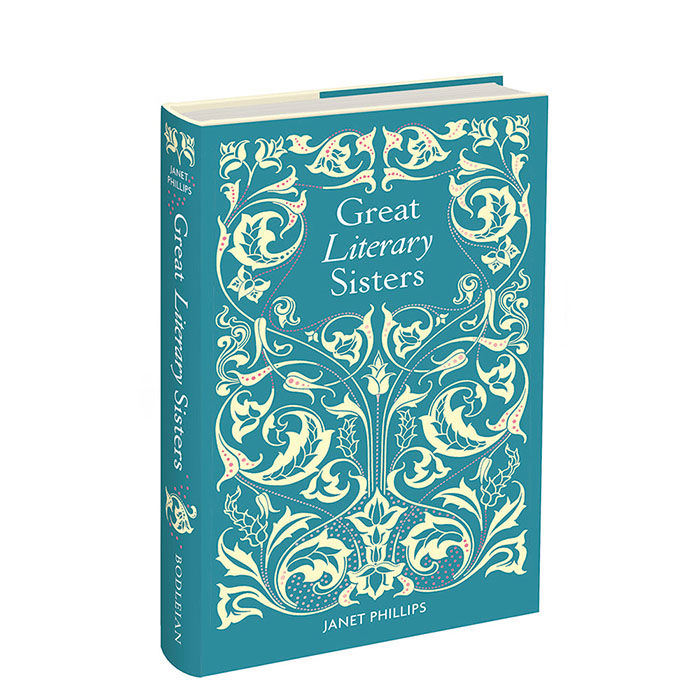

Read an extract from Great Literary Sisters
Castles in the Air
Meg, Jo, Beth & Amy
Little Women by Louisa M. Alcott
Louisa May Alcott (1832–1888) wrote Little Women (1868 & 1869) at the request of her publisher, who wanted her to write a ‘girls’ story’. Her family was bankrupt from her father’s failed attempt to set up a self-sufficient Transcendentalist commune in Concord, Massachusetts, and Alcott was already earning an income from her writing in order to support them, so she was used to pitching her stories for commercial success. Nevertheless, she knew that a girls’ story had to have an underlying aim of preparing girls for marriage and a domestic life, and she wrote in her notebook, ‘I don’t enjoy this sort of thing.’
But the novel, which drew heavily on her own childhood, was a resounding success, selling 2,000 copies in the first month of publication. Fans wrote in and clearly a sequel was called for, though Alcott complained: ‘Publishers are very perwerse & wont let authors have their way so my little women must grow up & be married off in a very stupid style.’1 Alcott herself, having achieved fame as an author, remained single all her life.
Who is your favourite March sister? Is it pretty Meg, who wishes to marry well and make a perfect home? Amy, the youngest, who wants to be an artist and an accomplished lady in society? Beth, who plays the piano beautifully and is happiest looking after everyone? Or, like many writers – Simone de Beauvoir, Gertrude Stein, Adrienne Rich and Cynthia Ozick, to name but a few – energetic, talkative Jo, who hates dresses and who wants to be a novelist. Why has this book won such a special place in readers’ hearts, and how does it, with its Victorian moral and Christian framework, continue to be popular in the twenty-first century?
As well as having distinct strengths, the four sisters also have distinct flaws, which, with the help of their ‘Marmee’, they are trying to overcome: Jo is hot-tempered, Meg is covetous of things she can’t afford, Amy is selfish and pretentious and Beth is shy and forgetful. These are all very recognizable – and forgivable – traits, for which many young girls may well have been criticized in their formative years, and Alcott ensures that every sister elicits our empathy.
Part I of Little Women famously opens at Christmas time and the theme of selflessness is firmly established. Not only do the girls decide to spend their Christmas dollars on presents for Marmee, but they are then asked to give their Christmas breakfast to a local family who have nothing to eat. The March family has had money in the past and lost it (although only Meg remembers this), and now the girls are encouraged not only to be content with their lot but also to give things up, a theme which recurs in both Little Women books.
It’s a tall order for four lively girls, and right up to the end of Part I they are still rebelling and making mistakes: Amy takes forbidden sour limes into school to impress her friends; Meg drinks too much champagne and flirts with Ned Moffat at the Moffats’ party; even angelic little Beth forgets to feed her canary, which starves to death.
Alcott allows them, particularly Jo and Amy, to transgress the expectations of how young girls should behave as much as she can within the constraints of a girls’ book, while Marmee looks on, like an all-seeing narrator, biding her time before dispensing advice. It’s as if the tensions in Alcott’s own life push through into the narrative. Jo, based on Louisa herself, is the most rebellious. She has deliberately shortened her name from Josephine to Jo, she is uninterested in girls’ clothes, having stained her gloves and burnt the back of her best dress by standing too close to the fire, and she wears a dressing-up outfit to write in, so that it doesn’t matter where she spills ink or wipes her pen. In a very brave move, she even sells her long hair to a barber when her mother needs the money for a journey to Washington to nurse their sick father. She becomes best friends with Laurie, the only grandson of their rich neighbour, who admires her ‘gentlemanly demeanor’, and they romp around together like brothers. Beth loves ‘harum-scarum’ Jo unconditionally, Meg finds her irritating and unladylike, and Amy has the youngest sister’s envy and frustration of trying and failing to compete.2
One of the reasons that Jo and Amy clash so often in the first part of Little Women is that they have a similar desire for financial independence and artistic ambition. Jo resents having to go and read to Aunt March as a way of earning money and wishes to find other ways: she wins a prize for her writing and by the end of Part I is on the path to bringing in a regular income from her short stories. Amy’s secret ‘castle in the air’ dream is to be the best artist in the world. This is revealed in a poignant and famous scene in which the sisters are sequestered in the shade of a clump of pine trees which they have named ‘the Delectable Mountain’ after The Pilgrim’s Progress, each having brought a work-in-progress with them (Jo a book, Amy a portfolio, Meg a cushion and Beth a basket). Laurie joins them and asks each to tell their secret dream. Jo will ‘write books, and get rich and famous’, Meg will have a pretty house, Amy will be ‘the best artist in the whole world’ and Beth will stay home and look after the family. They are passionate about their hopes, yet there is also a sense of fragility about all of them. Laurie’s ambition to be a musician is almost immediately squashed by Meg’s pronouncement that he must first put his wishes on hold and please his grandfather, who wants him to be a shipping merchant. This is an interesting prefiguring of the thwarted nature of Jo and Amy’s artistic careers, which will be interrupted by other developments in their lives. It is as if Alcott wants to even up the opportunities for boys and girls by putting duty in the way of her male character too, as she knows that marriage and motherhood will inevitably threaten the dreams of Jo and Amy.3
Amy lets go of her castle first. She tries many different artistic media, is invited to Europe by Aunt March’s friend and measures herself against the great painters: ‘It will decide my career’, she pronounces, ‘for if I have any genius, I shall find it out in Rome.’4 When she meets up with Laurie in France, however, she is on the brink of giving it up: ‘I want to be great, or nothing. I won’t be a common-place dauber, so I don’t intend to try any more.’5 She will put her efforts instead into being an ‘attractive and accomplished woman’ and marrying a rich man (as aunt March expected Meg to do). She sees this – the ability to make herself pleasing to others – as her own route to independence, and she clashes with Jo about it:
‘You can go through the world with your elbows out and your nose in the air and call it independence. … That is not my way.’6
Great Literary Sisters will be published by Bodleian Library Publishing on 23 April.
Janet Phillips is the author of Great Literary Friendships (Bodleian Library Publishing, 2022).
1 Quoted in Elaine Showalter, Sister’s Choice: Tradition and Change in American Women’s Writing, Oxford University Press, Oxford, 1991, p. 54.
2 Louisa M. Alcott, Little Women, Puffin Books, London, 1953, ch. 3.
4 Ibid., ch. 30
5 Ibid., ch. 39
6 Ibid., ch. 26