The English language had changed dramatically during the fifteenth century, in pronunciation, grammar, and vocabulary. Most noticeable was a change in pronunciation that philologists later called the Great Vowel Shift, when all the long vowels began to alter their qualities. In Chaucer’s day, a sentence such as ‘you need to make time to go now’ would have sounded more like ‘you nayd to mahk teem to gaw noo’, and the e at the end of such words as make and time would often have been sounded – ‘mah-kuh’, ‘tee-muh’. By the time Tyndale was born, the ‘shift’ was well under way, and that final e was no longer heard, though it would be another 200 years before most words would have pronunciations close to those we use today.
Major vocabulary change was also a feature of the time – something that gave rise to a lament by Caxton which has become famous in histories of the language. In the prologue to his translation of Virgil’s Aeneid he tells a story about a group of sailors whose ship was becalmed in the Thames Estuary, and they go on shore to find something to eat. At a local hostelry, one of them asks the cook for ‘eggys’ – a northern dialect form – and she doesn’t understand him. It takes another customer to explain to her that what the sailor wanted was ‘eyren’ – a southern form. Caxton wryly comments about the difficulty he faces, as a translator and printer (I’ve modernized the spelling): ‘Lo, what should a man in these days now write, eggys or eyren? Certainly it is hard to please every man because of diversity and change of language.’
The changes in vocabulary and grammar are especially noticeable if we compare an example of two versions of the same text, as in the two translations of the Bible from that time: the one associated with the name of John Wyclif, produced during the 1380s and 1390s, and Tyndale’s in 1526 and after. The opening words of John 7.24 in the earlier version would certainly have been challenging to a sixteenth-century reader: ‘Nile ye deme’. This shows a negative auxiliary form of will, followed by the verb deme in its old sense of ‘act as a judge’. The whole means ‘be unwilling to judge’. Tyndale’s succinct ‘Judge not’ became the later idiomatic norm. Similarly, we can compare Wycliffian ‘he is turned into woodnesse [= ‘madness’]’ in Mark 3.21 with ‘he had been beside himself’ (and King James ‘He is beside himself’). Or ‘For many ben clepid [= ‘be called’], but few ben chosen’ (Matt. 22.14) with ‘For many are called, but few chosen’ (King James adding an ‘are’). And then we have ‘Leech, heal thy self’ (Luke 4.23) beside ‘Physician, heal thy self’, which also became the idiomatic norm.
The sixteenth century was also notable for the way writers worried about the state of the language. As English increasingly became the rule in government and education, some wondered whether it was able to carry out the range of communicative functions that had been previously performed by French and Latin. The poet John Skelton, in The Book of Philip Sparow (1545), complained that English was ‘rusty … cankered … dull’, and lacked words that would enable him to write ‘ornately’. An adjective often used at the time to describe English was ‘base’, as seen in this comment by the traveller Andrew Boorde in The First Book of the Introduction of Knowledge (c. 1550): ‘The speech of England is a base speech [compared] to other noble speeches.’ And another common label was ‘rude’ (contrasted with French being ‘fair’): it meant ‘lacking in elegance or literary merit’. In Obedience, Tyndale hits back at that description, used by those who say the Bible ‘cannot be translated in to our tongue it is so rude’. He goes on, in typically abrasive vein:
It is not so rude as they are false liars. For the Greek tongue agreeth more with the English than with the Latin. And the properties of the Hebrew tongue agreeth a thousand times more with the English than with the Latin.
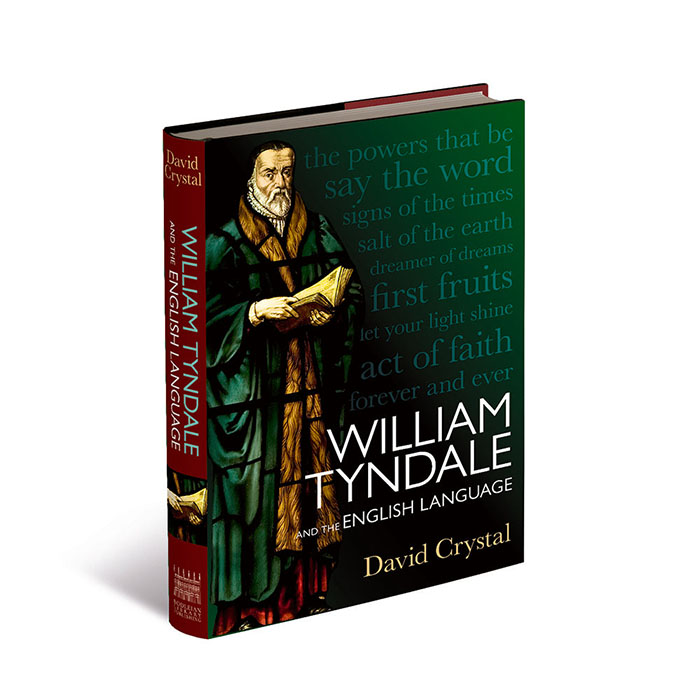
William Tyndale & the English Language is available now from Bodleian Library Publishing.
David Crystal is a writer, editor, lecturer and broadcaster on language, and honorary professor of linguistics at Bangor University. His many books include The Cambridge Encyclopedia of the English Language (Cambridge University Press, 3rd edition, 2019), A Date with Language (Bodleian Library Publishing, 2023) and Bookish Words (Bodleian Library Publishing, 2025).