

Read an extract from ‘Ten-Minute Book Club’
55. GIVE A NOD TO THE MODEST FUNGUS
Emily Dickinson wrote brilliantly about life in all its dimensions, from success, love, death, hope, light, and solitude to… mushrooms.
Emily Dickinson, ‘Vegetation's Juggler’ (1891)
The Mushroom is the Elf of Plants—
At Evening, it is not
At Morning, in a Truffled Hut
It stop opon a Spot
As if it tarried always
And yet it’s whole Career
Is shorter than a Snake’s Delay—
And fleeter than a Tare—
’Tis Vegetation’s Juggler—
The Germ of Alibi—
Doth like a Bubble antedate
And like a Bubble, hie—
I feel as if the Grass was pleased
To have it intermit—
This surreptitious Scion
Of Summer’s circumspect.
Had Nature any supple Face
Or could she one contemn—
Had Nature an Apostate—
That Mushroom—it is Him!
What we love
It feels like an ode (a lyric poem that addresses and often celebrates a person, place, thing, or idea, like ‘beauty’ and ‘truth’)—yet it’s not the standard subject matter for one. The poet lavishes attention upon the humble mushroom, singing its praises in the most exalted terms (what does ‘the Germ of Alibi’ even mean?) and then reins herself in with a final line that’s almost childishly sweet. It’s typical of Dickinson to notice things the rest of us might overlook or take for granted, and to invest them with dignity, wonder, and wit.
About the author
Emily Dickinson (1830–1886) is widely regarded as one of the most important and innovative of poets. She spent most of her life in Amherst, Massachusetts, living reclusively but writing constantly, both poetry and letters. Her work was published after her death and became an instant success. The first selections of her poems appeared in 1890; a fuller volume was published in 1955, but heavily edited; finally, an authoritative edition of Dickinson’s poems in 1998 (edited by R.W. Franklin) restored the sequence, idiosyncratic punctuation and spelling that she favoured. Franklin’s volume enriched and transformed our understanding of her poetry and its extraordinary scope, variety and complexity. As she herself once put it, ‘I have dared to do strange things—bold things.'
Where to next?
Shakespeare may have been in Dickinson’s mind when she penned this poem, as it echoes Prospero’s lines in The Tempest about how elves ‘make midnight mushrooms’. Huge mushrooms dot the dreamscape of Alice’s Adventures in Wonderland (1865) by Lewis Carroll. On one of these sits a Caterpillar who tells Alice that one side of the mushroom will make her taller and the other side will make her shorter. Sure enough, she finds that one side makes her shrink, while another makes her neck grow way up into the trees.
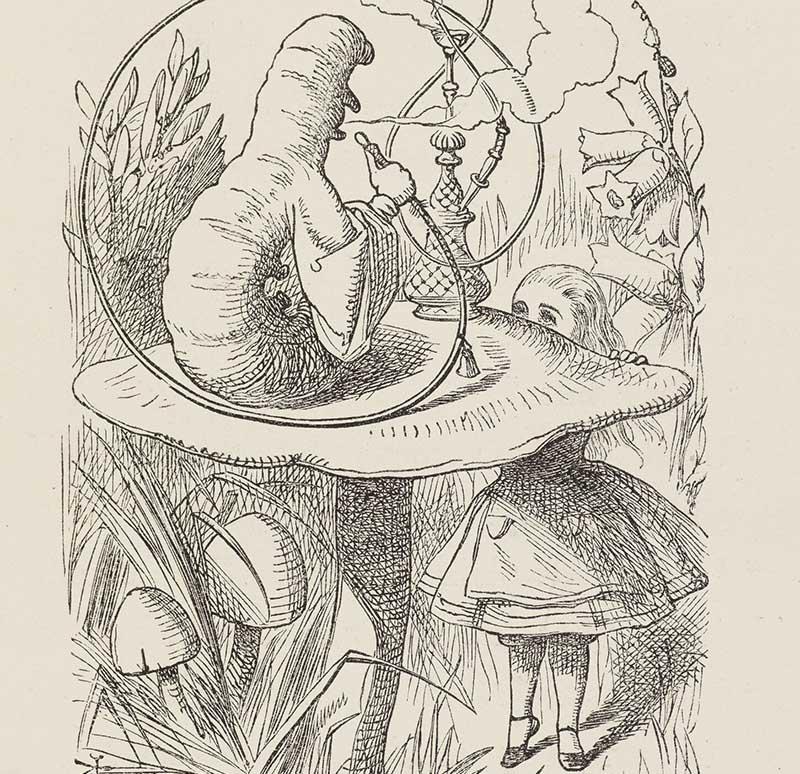
John Tenniel, 'Advice from a Caterpillar', from Lewis Carroll's 'Alice's Adventures in Wonderland' (Bodleian Library Arch. G e.49)
This theme of mushrooms having magical properties runs through much subsequent literature. For example, in H.G. Wells’s The Purple Pileus a mushroom radically alters the course of a man’s life. William Hope Hodgson’s ‘The Voice in the Night’ (1907) and H.P. Lovecraft’s ‘The Whisperer in Darkness’ (1931) capture the classic creepiness of mushrooms in the dark.
Mushrooms and the fairy world are an old theme too. The tale ‘Mushrooms’ in Alexander Afanasyev’s collected Russian Fairy Stories (1855–63), which contains folk stories from Russia, Ukraine and Belarus, begins:
A cep fell to thinking, and came to a decision. Sitting under an
oak, looking at all the other fungi, he began as follows:
You, white agarics, go to war with me…
In this brief story, talking mushroom types are framed through their cultural positioning as both a richly traditional human cuisine and yet also the dangerous food of the dead. The story hints at their growth in the dark moist forest floors; looking in the forest for mushrooms is itself risky. In many folktales, mushroom-gathering could very well lead to an encounter with the terrifying witch-like Baba Yaga!
There is a wealth of literature devoted to fungi more broadly… for starters, try the stories of Jeff VanderMeer, Jane Hertenstein, Paul Tremblay, Lisa M Bradley, Polenth Blake, Nick Mamatas, Ian Rogers and Ann K Schwader.
Ten-Minute Book Club is published by Bodleian Library Publishing.
KIRSTEN E. SHEPHERD is Professor of English and Theatre Studies at the University of Oxford and a Fellow of St Catherine’s College, Oxford. She founded LitHits in 2018.
ALEXANDRA PADDOCK is a Lecturer in Old and Middle English at Keble College, Oxford. She is a lead curator of LitHits.
DANIEL IBRAHIM ABDALLA is a Lecturer in English Literature at the University of Liverpool. He is a lead curator of LitHits.
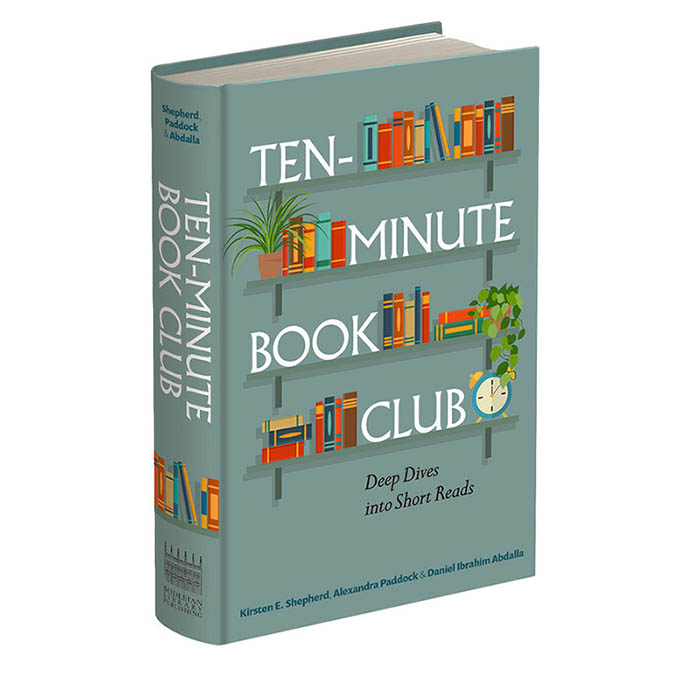
Ten-Minute Book Club: Deep Dives into Short Reads
Kirsten E. Shepherd, Alexandra Paddock and Daniel Ibrahim Abdalla
Bodleian Library Publishing
Hardback
328 pages
£16.99

