About this event
This talk starts with some basic facts in order to tender some equally basic – but presumably provocative nonetheless – observations. Chief amongst these is that the open internet, almost certainly the most comprehensive communications infrastructure in the world today, is no longer composed primarily of writing written by human beings. Instead, the overwhelming majority of writing in digital form – on any platform – is not only written by computers but also for other computers, in the form of manipulating and optimising search results, social media feeds, and the underlying content. This is not merely a case of ‘slop’ (a term implying only a problem of quality or value), but rather an epistemic shift in our relation to text as such, as a category of information (as well as a literal data format) which we can no longer assume to be for us, about us, or by us.
Is this the end of the internet as such, the vanishing point for the utility of digital communications? Or is it merely the fulfillment of the material and capital logics that have governed the internet all along? Are there other futures still possible, and what can those of us – in libraries and universities – hope to do about it?
Speakers
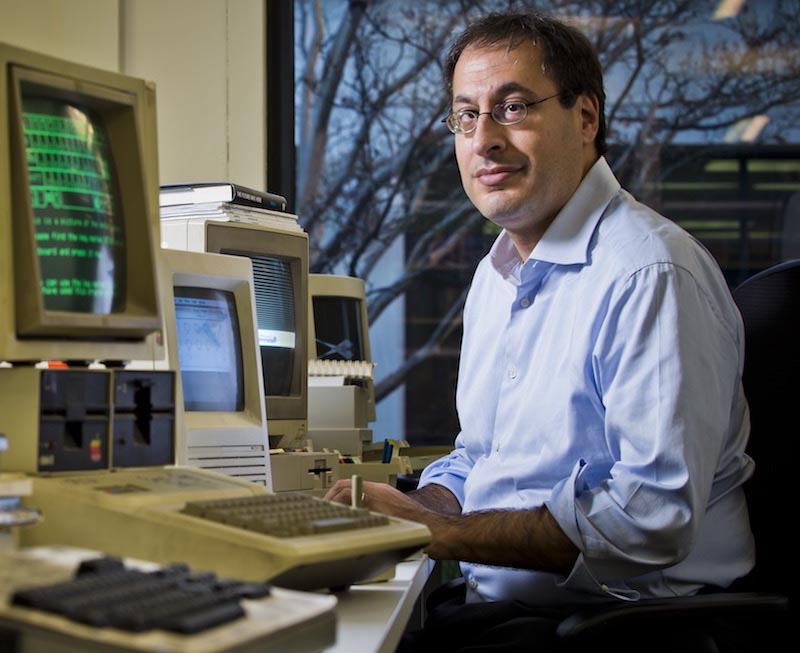
Matthew Kirschenbaum is Commonwealth Professor of Artificial Intelligence and Professor of English at the University of Virginia. A lifelong student of text and textuality in all its forms (he is also a practicing letterpress printer), he wonders now if text is how we meet our end.
Richard Ovenden OBE is Bodley’s Librarian and the Helen Hamlyn Director of the University of Oxford Libraries, and is responsible for their strategic oversight. He holds these posts alongside his role as Head of Gardens, Libraries & Museums (GLAM), University of Oxford. He has published widely on the history of collecting, the history of photography and on professional concerns of the library, archive, and information world.
Event information